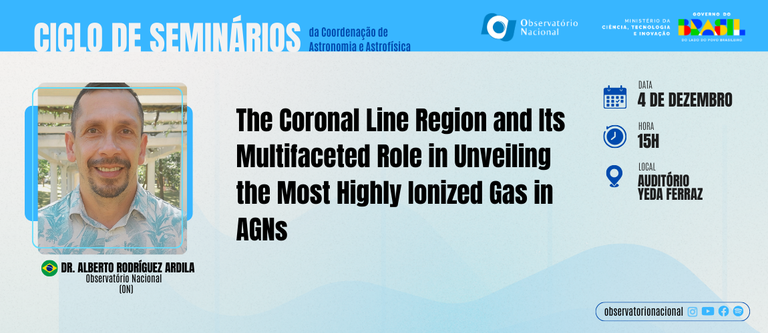
Doutor em Física pela Universidade Federal do Rio Grande do Sul, Alberto Ardia é pesquisador Titular do Laboratório Nacional de Astrofísica (LNA/MCTI) em Itajubá, MG. Possui experiência na área de Astronomia, com ênfase em Astrofísica Extragaláctica, atuando principalmente nos seguintes temas: galáxias Seyfert, linhas de emissão, galáxias ativas, galáxias no infravermelho e formação de linhas. Foi pesquisador visitante no Instituto de Astrofísica de Canarias, Espanha, e atualmente atua como gerente do Escritório Nacional do Telescópio Gemini e suporte técnico do Telescópio SOAR. É membro do corpo docente permanente dos programas de pós-graduação em Física da Universidade Federal de Itajubá e de Astrofísica no Instituto Nacional de Pesquisas Espaciais (INPE).
No dia 25 de agosto, às 11h, as Coordenações de Pesquisa do Centro Brasileiro de Pesquisas Físicas (CBPF) promovem o seminário “The Coronal Line Region and Its Multifaceted Role in Unveiling the Central Engine in Active Galactic Nuclei”, ministrado pelo pesquisador do Observatório Nacional (ON), Alberto Ardila. O seminário acontecerá no auditório do 6º andar na sede do instituto.
Beyond the classical broad-line region (BLR) at small nuclear distances and the kiloparsec-scale narrow-line region (NLR), a subset of active galactic nuclei (AGNs) exhibit emission lines from very highly ionized atoms, known as coronal lines (CLs). The nature and origin of these CLs have only recently begun to be clarified through adaptive-optics and seeing-limited IFU spectroscopy. In this talk, we present recent results obtained for an exquisite sample of AGNs that display coronal line regions with sizes ranging from hundreds of parsecs to a few kiloparsecs, enabling us to place new constraints on the extent of the coronal line region. We show that the extended CL emission is preferentially aligned with the radio-jet axis, with the spatial extent of the gas and line luminosity strongly correlated with jet power. The high-ionization gas is kinematically disturbed, exhibiting split line profiles that suggest expanding, rotation-decoupled gas. We measure blue- and redshifted components with velocities up to 400 km s⁻¹ relative to the systemic velocity, indicating that this material is likely in outflow. Finally, for Type I AGNs, we find that the strength of the unresolved coronal line emission scales inversely with the mass of the central supermassive black hole. This allows us to propose a new scaling relation for estimating black hole masses using single-epoch spectra. As an added benefit, this result naturally accounts for the absence of detectable CL emission in some AGNs.
Sobre o tema:
Sobre o palestrante: