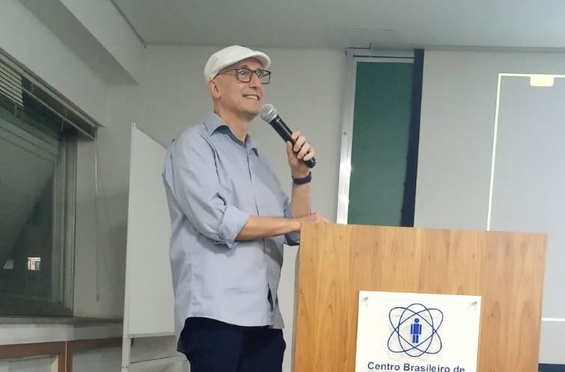
Foi contemplado com o prêmio Jovem Cientista do Nosso Estado (2018) pela Fundação de Amparo à Pesquisa do Estado do Rio de Janeiro (Faperj) e com a bolsa de pós-doutorado Banting (2013-2015) pelo Conselho de Pesquisa em Ciências Naturais e Engenharia do Canadá (NSERC).
Relativistic hydrodynamics has become an essential tool for describing the quark–gluon plasma produced in high-energy heavy-ion collisions, a novel state of strongly interacting nuclear matter. The success of hydrodynamic simulations in describing experimental data has led to important discoveries about the properties of this matter, most notably its behavior as an almost perfect fluid. Perhaps more surprisingly, heavy-ion physics has also driven major developments in relativistic hydrodynamics itself, leading to causal theories capable of describing dissipative effects beyond the regime of small gradients. At the same time, highly symmetric toy models of heavy-ion collisions, such as Bjorken and Gubser flow, have provided remarkable theoretical laboratories in which fundamental properties of hydrodynamics can be studied in unprecedented detail, including high-order gradient expansions and hydrodynamic attractors.
Possui graduação em Física pela Universidade Federal do Rio de Janeiro (2006), mestrado em Física pela Universidade Federal do Rio de Janeiro (2009) e doutorado em Física teórica pela J.W, Goethe Universität (2012). Atualmente é professor adjunto da UFF. Suas pesquisas envolvem o estudo do plasma de quarks e glúons. Dedica-se a investigar como teorias hidrodinâmicas e de transporte emergem no regime relativístico e como tais teorias podem ser usadas para descrever a matéria criada em colisões ultra relativísticas de íons pesados.
Sobre o palestrante:
I will discuss how these developments have shaped our understanding of the emergence and limitations of relativistic hydrodynamics, and how this knowledge is now being transferred to astrophysics, particularly to neutron stars and their mergers. I will focus on a recent study of neutron-star oscillations that asks whether different formulations of dissipative hydrodynamics necessarily give the same predictions. We find that the finite size of neutron stars and the constraints imposed by causality can prevent the system from reaching the asymptotic hydrodynamic regime, allowing microscopic relaxation effects to leave significant imprints on the stellar oscillation spectrum.
Sobre o tema:
No dia 29 de setembro, às 11h, as Coordenações de Pesquisa do Centro Brasileiro de Pesquisas Físicas (CBPF) promovem o seminário “From Heavy-Ion Collisions to Neutron Stars: Testing the Limits of Relativistic Hydrodynamics”, ministrado pelo professor da Universidade Federal Fluminense (UFF), Gabriel Silveira Denicol. O seminário acontecerá no auditório do 6º andar na sede do instituto.